JOIN

ALOHA · A LINEAR OPEN-HARDWARE ACCELERATOR

THE MACHINE

ALOHA, A Linear Open-Hardware Accelerator, is built in stages, ordered by risk and by who will use them; the numbers follow the order they were proposed. We aim to design, simulate, build and document each one in the open before the next.

  • SOLID · BUILT OR MEASURED
  • HATCHED · SIMULATED
  • OUTLINE · DESIGN OR PLANNED

ALOHA-1, the line. Schematic, not to scale.

STAGE 0 · DEMONSTRATOR

Model-0

BUILT

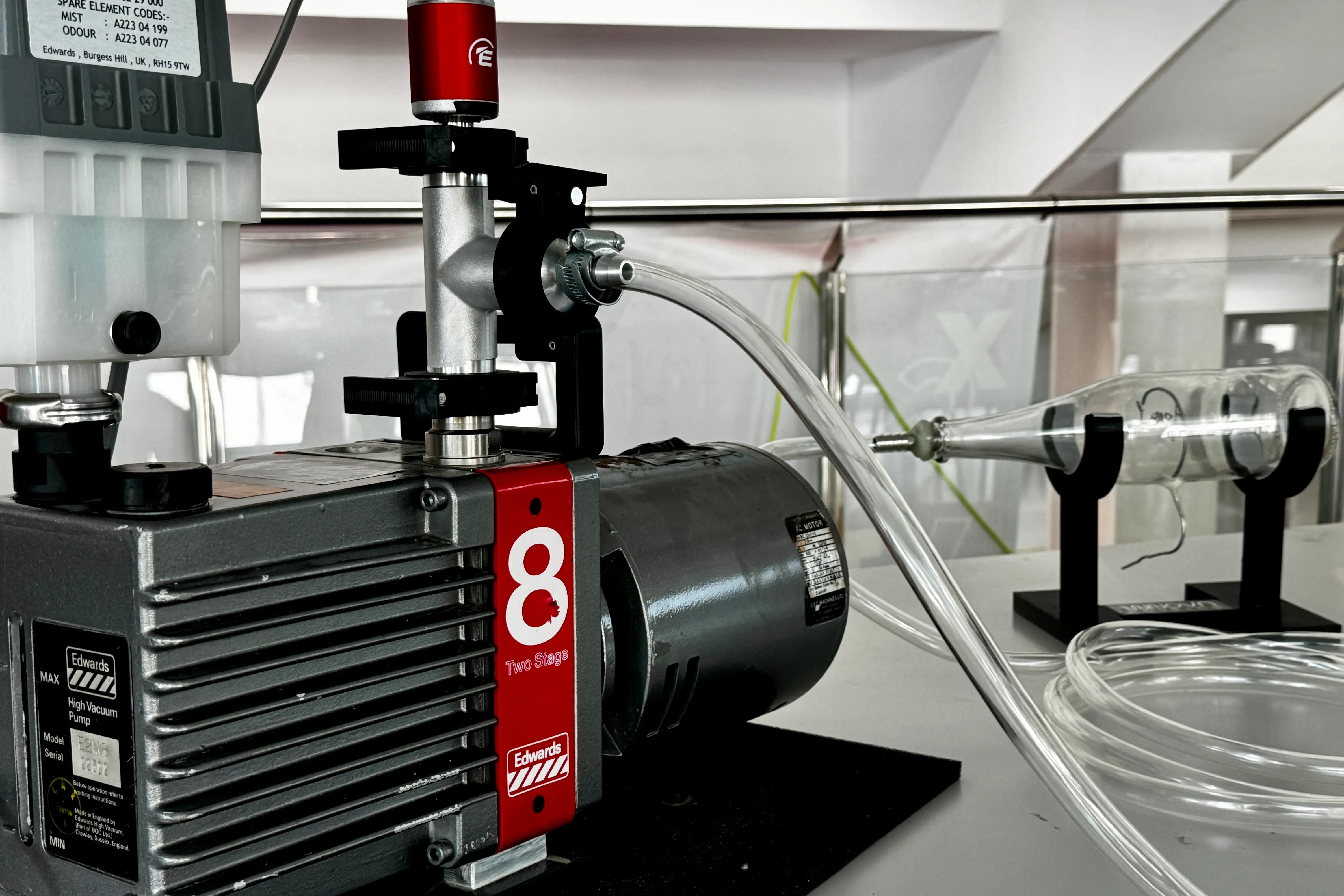
A glow-discharge demonstrator that makes the path of a beam visible. It brought Edwards Vacuum on board as our first sponsor.

Model-0 in numbers
QUANTITYVALUESTATUS
Pressure, operating1.7 TorrMEASURED · PIRANI GAUGE · 7 JULY 2026
Supply, isolated10 kVBUILT
Model-0 on the bench: an Edwards vacuum pump connected to the glass tube where the discharge glows.
Model-0 on the bench. The vacuum pump and the glass tube where the discharge glows.

STAGE 1 · THE ELECTRON SOURCE

ALOHA-0

SIMULATED

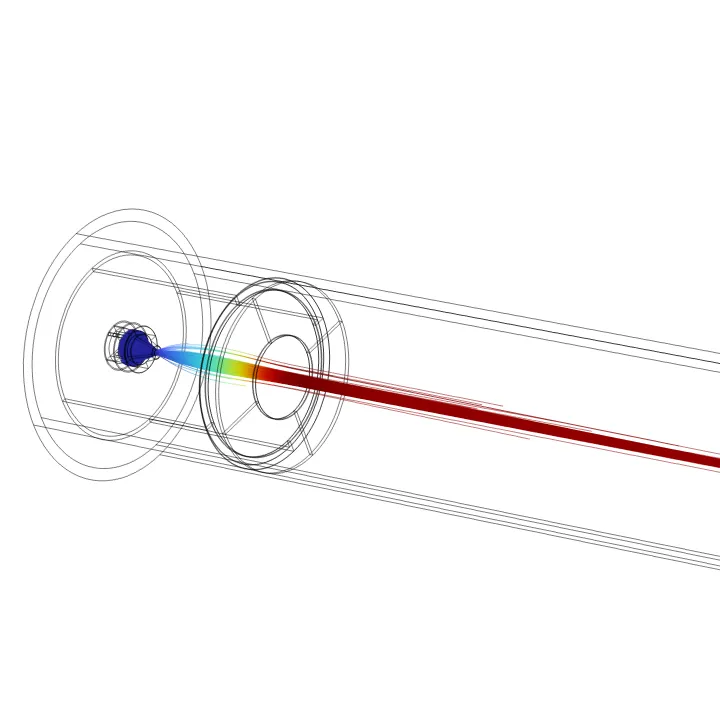
The electron source: a thermionic telefocus triode. A tungsten hairpin cathode and a Wehnelt cylinder at −20 kV face a grounded anode, and the Wehnelt shapes the emission so the beam focuses far beyond the anode. The 20 keV beam ends on a graphite collector inside a closed chamber, which stops it and measures its current. We build it once, to the beam requirements of ALOHA-2.

ALOHA-0 in numbers
QUANTITYVALUESTATUS
Beam energy20 keVDESIGN
Beam current<1 mADESIGN
Extraction voltage, as simulated30 kVSIMULATED · COMSOL
Beam current, as simulated1.5 mASIMULATED · COMSOL
Beam spot, as simulated<1 mmSIMULATED · COMSOL
CathodeW hairpin, thermionicDESIGN
Beam stopGraphite collectorDESIGN
ExperimentSmith-Purcell sub-THzPROPOSED
COMSOL simulation of the ALOHA-0 electron source: the electrodes in thin grey lines on white, and the electron beam leaving the cathode, coloured from blue to red as it crosses the anode.
The source, simulated in COMSOL. Cathode and Wehnelt on the left, the anode in the middle, and the beam leaving through it.

STAGE 2 · THE INSTRUMENT

ALOHA-2

PROPOSED

ALOHA-0 plus a target that turns its beam into X-rays, a window that lets only the X-rays out towards a painting, an energy-dispersive detector, shielding and a scanning stage. At 20 keV it reads the core of a restorer’s palette without taking a sample; the 20 keV ceiling protects the paintings.

ALOHA-2 in numbers
QUANTITYVALUESTATUS
Beam energy20 keVDESIGN TARGET
TechniqueX-ray fluorescencePROPOSED
Elements readCa, Fe, Cu, As, Hg, PbDESIGN TARGET
UseX-ray spectroscopy of pigmentsAIM

STAGE 3 · ACCELERATION · CONDITIONAL

ALOHA-1

DESIGN

Adds pre-acceleration, a buncher and an accelerating structure at 2.998 GHz, fed by a second ALOHA-0, up to 1 MeV, with an experiment at the end of the line. It is conditional: we build it once a research group commits to using it. Until then it advances without beam, in the design and cold tests of its cavities.

ALOHA-1 in numbers
QUANTITYVALUESTATUS
Beam energy1 MeVDESIGN TARGET
RF frequency, S-band2.998 GHzDESIGN
Buncher4 cavitiesDESIGN
Accelerating structure4 cavitiesDESIGN

2026-27

This year

The least we aim for: the vacuum system, pumped down and measured, with its control electronics tested.

  1. VACUUM SYSTEMSEMESTER 1 · BUILD

  2. VACUUM CONTROLSEMESTER 1 · BUILD

  3. CATHODE SUPPLYAFTER THE VACUUM · DEPENDS ON FUNDING

  4. OPEN DOCUMENTATIONTARGET · BEFORE JANUARY 2027

  5. ALOHA-2 REQUIREMENTS MEETING2026-27

  6. ALOHA-1 CAVITY DESIGNDESIGN · THROUGH THE SEASON

OPEN

Everything we design stays open

  • CERN-OHL-S

    The hardware licence: strongly reciprocal, so whatever is built from our designs stays open too.

  • GitHub

    The public record of the design process: reports, inputs and the reasoning behind every number.

    COMING · THE DOCS REPOSITORY

  • Handbook

    How the team works, as a public online book.

    EDITION 2026-27